Fuel for Focus began with firsthand experience of what happens when the usual study advice does not fit. Fo-Bot helps neurodivergent learners notice their own patterns and find strategies worth trying.
A lot of neurodivergent students are told to try harder when the method itself is the problem. Fuel for Focus helps students identify the conditions, tools, and study habits that make learning feel more manageable.
Fo-Bot was built to turn a student's answers into a clear learner profile with study ideas that can be tested in real life. It is a starting point for self-understanding, not a diagnosis.
A free workshop is being developed with the school guidance department to help younger students talk about focus, learning differences, and why one method will never work for everyone.
Fuel for Focus shares practical ideas and honest student perspectives so neurodivergent learners can recognize themselves in someone else's experience and feel less alone.
Fo-Bot is a free, guided questionnaire that helps you notice patterns in how you focus, process information, remember what you learn, and get started on schoolwork.
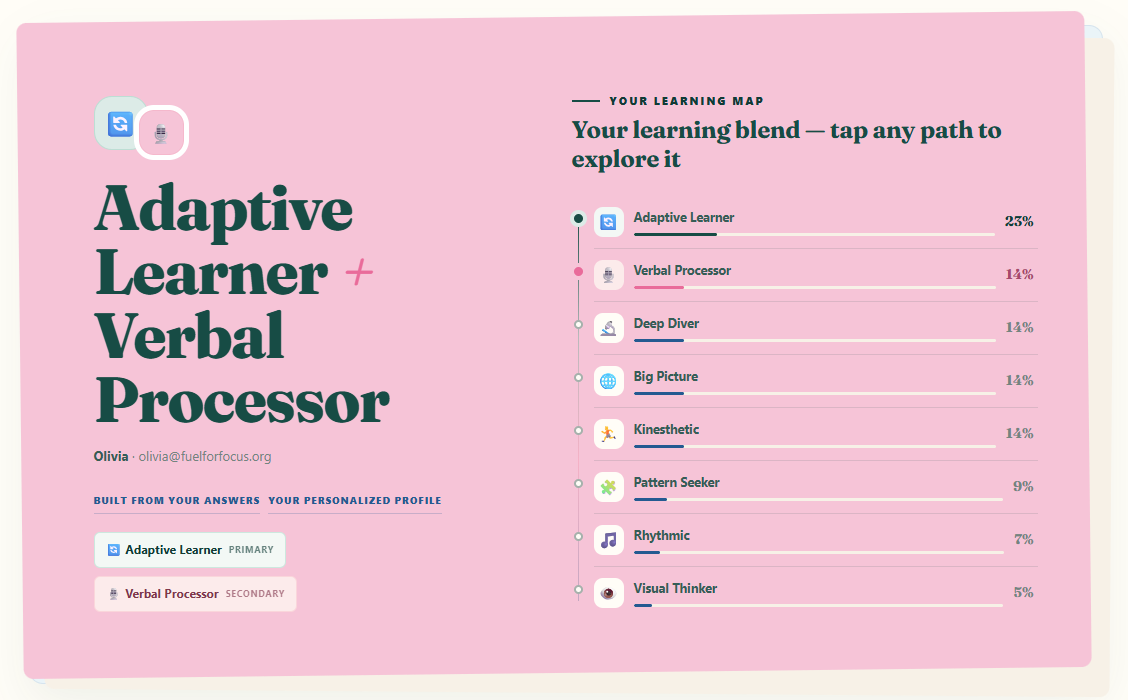
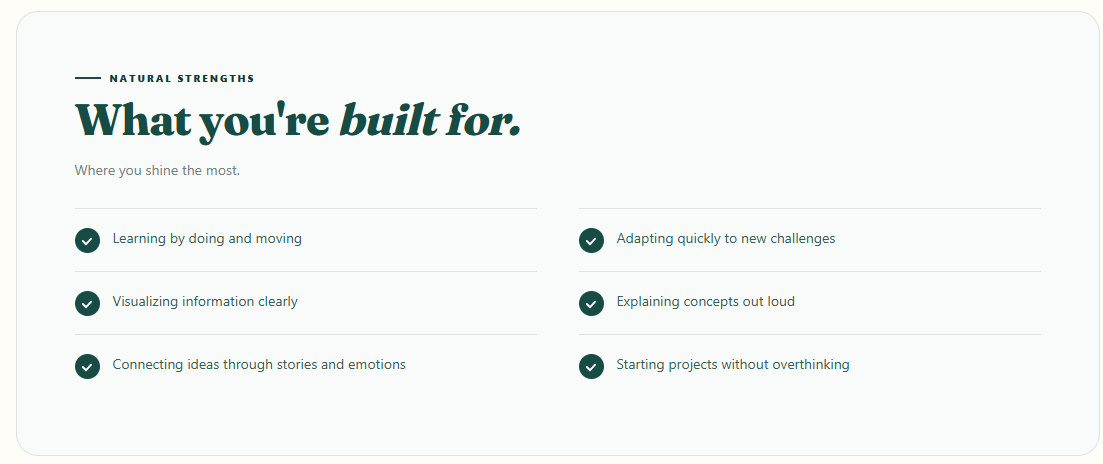
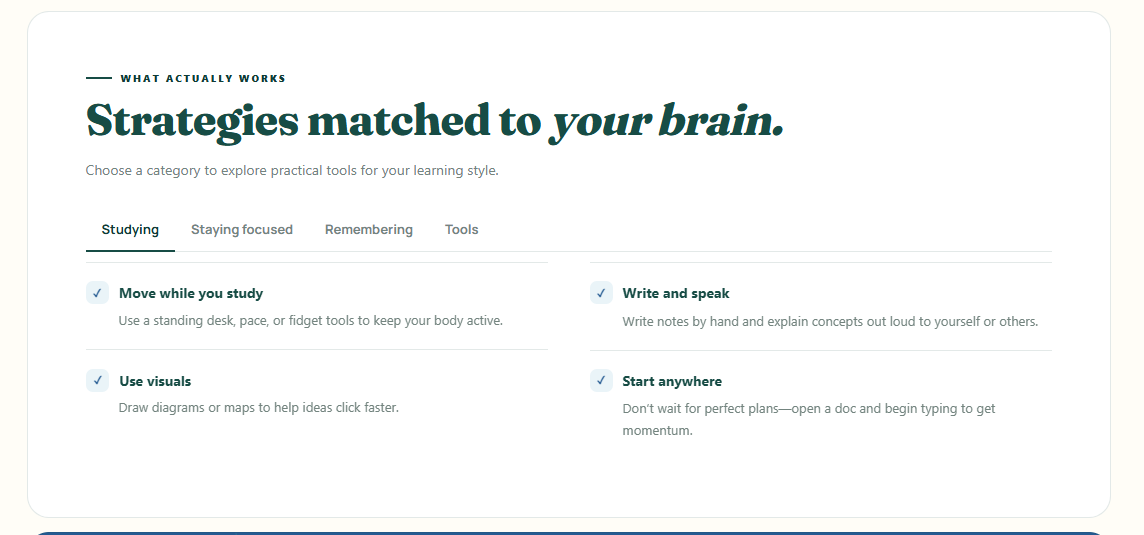
After you answer the questions, Fo-Bot creates a personalized Learner Profile. It shows what may be helping you, what may be getting in the way, and which strategies could be worth trying.*
*Fo-Bot was shaped by learning research, firsthand neurodivergent experience, and feedback from neurodivergent students. It is an educational tool, not a medical or psychological diagnosis.
Hi! I'm Fo-Bot.
Tell me what studying actually feels like for you, and I'll help you spot the patterns.
Answer 15 questions and get a learner profile with study strategies, focus ideas, and practical things to try.
Fuel for Focus began with firsthand frustration with study advice that never seemed to fit. Fo-Bot was built independently, then rebuilt as feedback from other neurodivergent students revealed what the first version had missed.
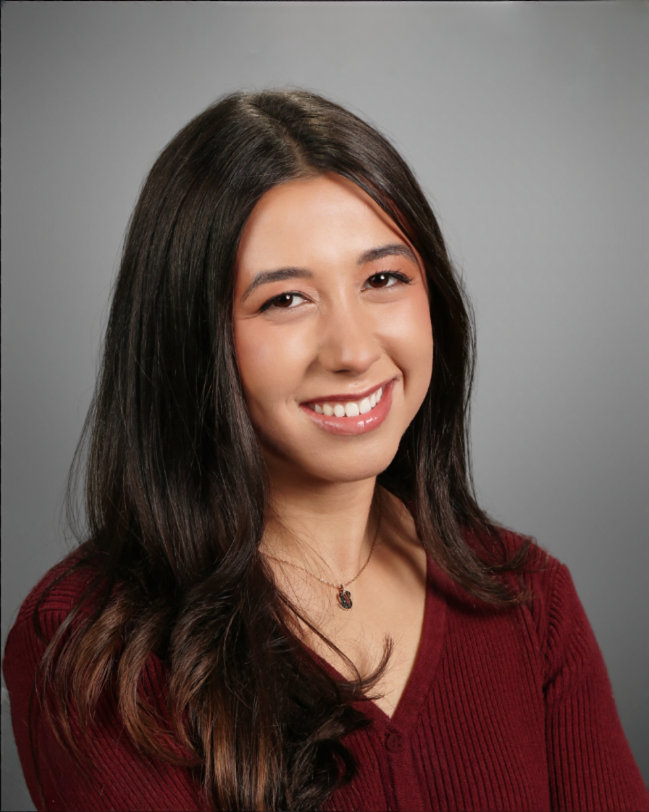
See How Fo-Bot Was Built ↗If you'd asked me what kind of student I was a few years ago, I probably would have said I felt lost, or out of order. Staying focused and studying the way I was told to never really made sense to me, and for a long time I figured that meant something was wrong with me.
I don't think that anymore, not because I fixed my brain, but because I fixed the way I saw it. Being neurodivergent means a lot of traditional study methods just don't work for me the way they seem to for everyone else. But it also means I've learned to find my own way through things, and over time I've stopped seeing that as a flaw and started seeing it as one of my biggest strengths.
That's really where Fuel for Focus came from. I spent months reading about learning science and neurodivergence on my own, then used that to build Fo-Bot, which took a lot of trial and error. I ended up rebuilding it more than once after actually surveying neurodivergent students and realizing some of what I thought would help wasn't quite right.
We're still growing and still figuring a lot of this out. But the goal has stayed the same since the beginning: help other students understand their own minds the way I've had to learn to understand mine.
The current team supports outreach, operations, and fundraising. Product development remains with the founder.
The team is working with its school guidance department to shape a free workshop for middle school students. The focus is practical: how attention and learning can differ, how to notice what helps, and how to ask for support without feeling ashamed.
Ask About a WorkshopStudents, educators, counselors, and community partners are welcome to reach out. Tell us who you are and what you have in mind.
Answer 15 questions about how you focus, remember, and study. Fo-Bot looks for patterns and turns them into a clear profile with strategies you can test.
Start the QuestionnaireHi! I'm Fo-Bot. Your answers give me the raw material; my job is to organize the patterns and explain them clearly.
The questions ask about real situations: how you begin a task, what pulls your attention away, how you remember new material, and which study methods feel natural or frustrating.
When you submit, your name, email, and answers are saved in the Fuel for Focus database so your profile can be generated and retrieved later. The Privacy Policy explains the full data flow.
Fo-Bot uses the OpenAI API to look for patterns in how you take in information, organize tasks, stay engaged, and remember what you have learned. Fuel for Focus's instructions shape the profile it produces; your answers are not used to diagnose a condition.
Your profile summarizes the patterns Fo-Bot noticed and suggests study methods, focus supports, and environmental changes. Treat the recommendations as experiments: keep what helps, skip what doesn't, and adjust as you learn more about yourself.
A simple view of the steps between submitting the questionnaire and opening your profile.
This example shows the format. Your own profile will reflect your answers.
Published learning frameworks were combined with direct feedback from neurodivergent students. The questionnaire was then rebuilt when those answers challenged the original assumptions.
The questions were informed by VARK and multimodal-learning concepts. These frameworks can offer useful language, but they are not fixed rules or diagnoses.
Feedback was gathered directly from neurodivergent students about the conditions and strategies that actually help them learn.
The questionnaire and Fo-Bot instructions were revised more than once as testing revealed what was clear, what was too broad, and what students found useful.
It takes about five minutes. Use the result as a starting point, then keep what genuinely helps.
What the Fo-Bot questionnaire collects, why it is needed, where your answers go, and how to request deletion.
When you use the Fo-Bot questionnaire, we collect the name and email you provide, along with your answers to the questions.
Your name and email allow your results to be saved and retrieved. Your answers are used to generate your learner profile.
Your questionnaire answers, but not your name or email, are sent to OpenAI's API to generate your learner profile. OpenAI processes those answers to produce the result and does not receive your name or email.
Your responses and generated profile are stored in the Fuel for Focus database so you can return to them later.
We do not sell your information, share it with advertisers, or use your answers to market unrelated products or services.
We currently retain your information while the Fo-Bot tool remains active so you can retrieve your profile. You may request deletion at any time by emailing us.
Fo-Bot is designed for students, including middle and high school students. Users under 13 should use the questionnaire only with a parent or guardian involved. A parent or guardian may contact us with questions or a deletion request.